




When will UAE fuel prices start dropping?
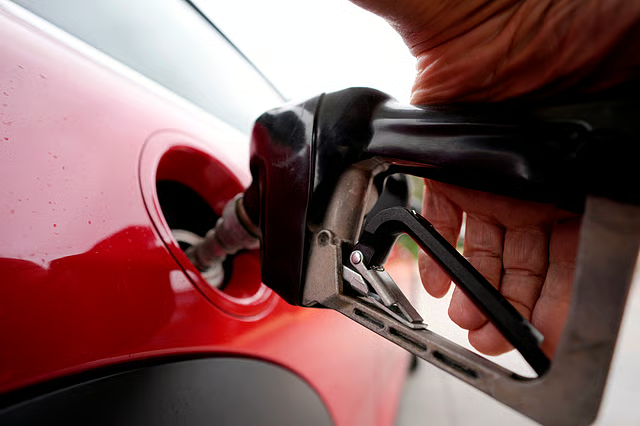

After four consecutive months of fuel price increases, many UAE motorists are hoping relief is finally around the corner.
There are signs that global oil markets are cooling. Brent crude, the international benchmark, is trading around $97 a barrel, down from the $110-$120 levels seen earlier this year when disruptions to Gulf shipping routes sent energy prices soaring.
But economists warn that a return to significantly cheaper fuel may still be some distance away. The UAE raised petrol prices again for June, taking Super 98 to Dh3.95 a litre, Special 95 to Dh3.83, and E-Plus 91 to Dh3.76. Diesel, meanwhile, eased to Dh4.33 per litre after reaching much higher levels in previous months.
For motorists, that means fuel remains substantially more expensive than it was at the start of the year. Super 98 has climbed from Dh2.45 per litre in February to Dh3.95 in June, a jump of more than 61% in just four months.
For a typical driver filling a 60-litre tank, that translates into a fuel bill of about Dh237 today versus Dh147 in February — roughly Dh90 more every time they refuel.
Why prices are still high
The main reason is oil. Although crude prices have retreated from their recent peaks, they remain elevated because of continuing uncertainty surrounding the conflict involving Iran and the future of shipping through the Strait of Hormuz.
The waterway handles roughly 20% of global oil supplies, making it one of the most important energy routes in the world.
Recent optimism surrounding US-Iran negotiations and ceasefire efforts has helped push oil below $100 a barrel. Markets are increasingly betting that a diplomatic solution could eventually allow shipping flows to normalise.
That has reduced some of the panic buying that drove crude sharply higher earlier this year. Yet economists say lower oil prices are likely to arrive gradually rather than suddenly.
Slower path to lower prices
Gita Gopinath, Deputy Managing Director of the International Monetary Fund and formerly its Chief Economist, said oil prices are unlikely to return quickly to the levels seen before the conflict.
“We are not going to see the price of oil come down all the way very quickly,” Gopinath said. “It’s going to take probably till the middle of next year for oil to come back to say $70 or $75 a barrel.” She added: “There is going to be an effect lasting into next year.”
That timeline is important for UAE motorists because fuel prices are directly linked to global oil markets through the country’s monthly fuel-pricing mechanism.
That has reduced some of the panic buying that drove crude sharply higher earlier this year. Yet economists say lower oil prices are likely to arrive gradually rather than suddenly.
Slower path to lower prices
Gita Gopinath, Deputy Managing Director of the International Monetary Fund and formerly its Chief Economist, said oil prices are unlikely to return quickly to the levels seen before the conflict.
“We are not going to see the price of oil come down all the way very quickly,” Gopinath said. “It’s going to take probably till the middle of next year for oil to come back to say $70 or $75 a barrel.” She added: “There is going to be an effect lasting into next year.”
That timeline is important for UAE motorists because fuel prices are directly linked to global oil markets through the country’s monthly fuel-pricing mechanism.
What could happen next?
Based on current oil market trends, the most likely scenario is a gradual easing rather than a sharp drop. If Brent crude remains below $100 a barrel and tensions continue to ease, UAE fuel prices could begin seeing modest downward adjustments over coming months.
The pace of any decline will depend on how quickly global oil supplies recover and whether shipping activity through the Strait of Hormuz returns to normal levels.
Because UAE fuel prices are based on monthly average oil prices rather than daily movements, changes in crude prices typically take time to filter through to consumers.
That means even if oil falls further this month, motorists may need to wait several pricing cycles before seeing a meaningful difference at the pump.
Risk that could delay relief
Economists are also warning against assuming the crisis is over. Gopinath cautioned that markets may be underestimating the risk of a prolonged disruption.
“If this continues for another month, we’re looking at oil prices that could go up to like $120 and $140 a barrel and could stay there for much longer,” she said. Such a scenario would likely push fuel prices higher again and add pressure to inflation globally.
The warning is echoed by the OECD (Organisation for Economic Co-operation and Development). The 38-member intergovernmental organization says the global economy remains highly exposed to prolonged energy disruptions. “The longer the disruption lasts, the greater the economic, but also the social cost of this crisis,” said Stefano Scarpetta.
The OECD forecasts global growth slowing to 2.8% in 2026 if Gulf oil and gas exports return to pre-conflict levels later this year. If disruptions continue into 2027, global growth could slow sharply to 2.1%, with some economies facing recession risks.
When will motorists get relief?
The answer depends largely on one number: oil. If crude prices continue moving lower and remain below $100 a barrel, UAE motorists could begin seeing fuel prices stabilise and gradually ease in the months ahead
But based on current forecasts from economists and international organisations, a return to the much lower fuel prices seen at the beginning of 2026 is unlikely in the near term.
For now, the sharp spikes appear to be over. The next phase is more likely to be gradual cooling rather than a rapid drop.
GN