




Why forcing the strait open is high risk

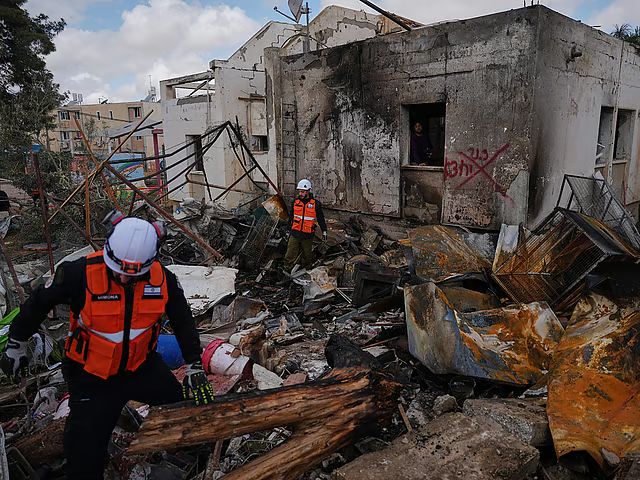
As the war between the United States and Iran has entered its fourth week, the Strait of Hormuz has become the conflict’s most critical — and volatile — battlefield.
The narrow chokepoint, through which a significant share of the world’s oil passes, is now effectively paralysed.
Iran has largely blockaded the strait, snarling oil shipments and disrupting global trade.
Tehran, however, insists the waterway remains open to all shipping except vessels linked to what it calls its “enemies,” framing the disruption as a targeted response rather than a full closure.
The impact has already rippled through energy markets, pushing up fuel prices globally.
For Washington, reopening the strait is no longer just a military objective — it is an economic and political imperative.
But doing so may prove far more difficult than it appears.
The stakes have risen sharply in recent hours, underscoring how quickly the crisis could escalate.
Iran’s threat
Iran on Sunday threatened to target key infrastructure across the Middle East if US President Donald Trump follows through on his warning to “obliterate” the country’s power plants unless the Strait of Hormuz is fully reopened within 48 hours.
In a post on Truth Social, Trump issued the 48-hour ultimatum, sharply escalating pressure on Tehran’s leadership.
Iran’s military command responded that any such strike would trigger attacks on US-linked “energy, information technology and desalination infrastructure” across the region — signalling the risk of a much wider conflict.
The administration of Donald Trump is weighing several options, according to The New York Times, each carrying significant risk, complexity and the potential for escalation — with no quick or guaranteed solution in sight.
Analysts say Washington could next step up military, economic and naval pressure — from intensified strikes to tanker escorts — as it seeks to force Iran to reopen the Strait of Hormuz without triggering a wider war.
At a glance: Strait of Hormuz blockade
- ~20% of global oil & LNG flows through Hormuz in peacetime
- 24 vessel incidents reported since March 1, including 11 tankers (UKMTO)
- 8 seafarers killed, 4 missing, 10 injured (IMO)
- Shipping down ~95% — from ~120 daily transits to just 124 crossings in 3 weeks
- ~20,000 people affected, including seafarers, port workers and offshore crews
- 3,200 vessels stranded in the region, many large commercial ships
- 250 oil tankers stuck in the Gulf (≈5% of global tanker capacity)
- Ship fuel prices up ~90%, while crude shipping costs have doubled
Destroying threats from the air
The most immediate strategy is to neutralise Iran’s ability to target ships from land.
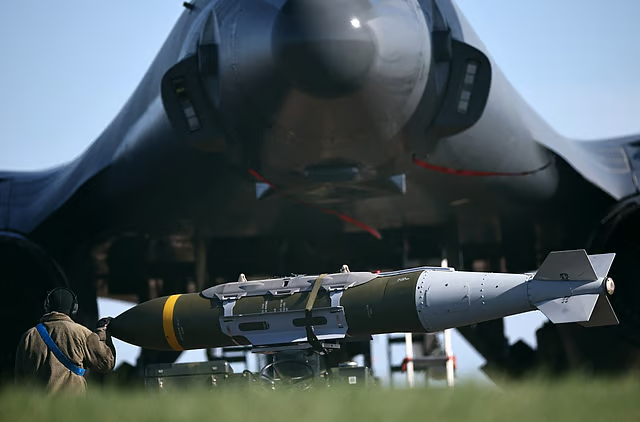
US warplanes have intensified strikes along Iran’s southern coast, targeting missile launchers, drone facilities and underground bunkers. Officials say the goal is to reduce the threat to slow-moving oil tankers before attempting to move them through the strait.
But even after weeks of bombardment, Iran retains residual capabilities. Military officials acknowledge that while its strike capacity has been significantly degraded, it has not been eliminated.
That means any attempt to reopen shipping lanes would still carry risk.
The minefield problem
Even more dangerous is the possibility that Iran has mined the strait.
Naval mines — some attached directly to ships, others floating just below the surface or lying on the seabed — are among the simplest yet most disruptive weapons in maritime warfare. A single successful strike could halt traffic entirely.
Clearing them is a painstaking and time-consuming process. Experts say it could take weeks, requiring specialised ships and exposing sailors to direct danger.
Worse, uncertainty itself is enough to paralyse shipping. Even the suspicion of mines can deter commercial vessels from entering the waterway.
Iran’s swarm tactics at sea
Beyond missiles and mines, Iran’s naval strategy relies heavily on speed and unpredictability.
The country’s Revolutionary Guard operates hundreds of fast-attack boats — small, agile vessels capable of launching sudden strikes using rockets or drones. These “swarm” tactics are designed to overwhelm defences and create chaos in crowded shipping lanes.
The US military has deployed aircraft such as A-10 warplanes to hunt these vessels, while also targeting drone storage sites along the coast. But Iran’s use of civilian ports to shelter assets complicates targeting and raises the risk of collateral damage.
A high-risk escalation: Kharg Island
One of the most aggressive options under consideration is a potential move against Kharg Island, Iran’s main oil export hub.
US strikes have already weakened defences there, hitting dozens of military targets. Some officials believe seizing or disabling the island could cripple Iran’s ability to finance the war.
But such an operation would mark a major escalation. Amphibious assaults involving thousands of Marines — or elite airborne units — would face resistance from entrenched Iranian forces and risk drawing the United States deeper into the conflict.
Even within the administration, there are mixed signals. While Trump has threatened decisive action, he has also publicly downplayed the likelihood of deploying ground troops.
Escorting tankers: Simple in theory, complex in reality
Another option — escorting commercial tankers through the strait — may sound straightforward, but military planners say it is among the most complicated.
Such operations require large numbers of naval assets, including destroyers equipped with advanced missile defence systems, supported by aircraft overhead. Even then, protecting slow-moving ships in a confined waterway remains a daunting challenge.
Past experience underscores the danger. During the 1980s “tanker war,” US-escorted vessels were still struck by mines and missiles, resulting in significant damage and loss of life.
A battlefield with no easy answers
Each option carries serious risks — from prolonged military engagement to wider regional escalation.
For now, the Strait of Hormuz stands as both a strategic chokepoint and a symbol of the war’s growing complexity.
Reopening it is essential — but doing so without triggering a broader conflict may prove far more difficult.
GN


