





Could Hormuz make Iran rich? Military says ‘Yes’

India is hosting Iranian Foreign Minister Abbas Araghchi in Delhi for the BRIC Foreign Ministers’ Meeting (May 14-15). On Thursday, Araghchi urged countries to unite against US “bullying”.
On the same day, Iran’s military attacked and sank an Indian-flagged vessel in the waters off Oman.
The disconnect between Tehran’s words and actions is awkward at best, and ridiculous at worst: India deplored the move, calling it unacceptable.
The attack was no accident: It’s part-strategy and part-disconnect.
So while the country’s diplomats publicly call for peace and seek international sympathy, hardliners invoke control of Hormuz as both an economic lifeline and a point of “leverage”.
The regime reckons that this shift will yield swift economic and political gains
Economic, political gains
It won’t, say experts.
The regime’s military spokesman said that Tehran’s control over Hormuz could generate “significant” economic revenue and strengthen the country’s international position.
Tighter control or disruption of maritime traffic there could also amplify Tehran’s influence on the world stage.
The Indian-flagged dhow (mechanised wooden sailing vessel) named Haji Ali was attacked and sank off the coast of Oman near the Strait of Hormuz, on May 14, 2026, based on reports. All 14 crew members were rescued by the Omani Coast Guard.
This ignores one reality: the “counter-blockade” imposed by the US military since April 13, 2026.
Before February 28, 2026, the oil market was operating with a Brent crude price of just $61-$63/barrel (January 2026 average).
The war changed the calculus: while other Gulf producers saw exports drop significantly, Iran’s exports reportedly increased from 1.1 million to 1.5 million barrels at >$100/barrel.
As of mid-May 2026, however, Iran’s oil sector faces severe pressure from the US blockade. Reports suggest a potential loss of over $5 billion in revenue.
Despite the blockade causing export bottlenecks and shipping risks, Iran claims its output stayed at around 1.8 to 2 million barrels per day through increased domestic refining and storage.
Trump, however, said the US blockade has “allowed no money” for the regime for more than a month now.
Iran’s leverage
In throttling exports or escalating risk around the strait, the Iranian regime seeks to impose economic leverage, driving up global energy prices and extracting concessions in sanctions and diplomatic talks.
By disrupting a vital international artery, it forces global attention, compels mediators to involve negotiations on terms it prefers.
It also forms an asymmetric warfare narrative.
Coastal batteries, fast-attack craft, mines, and small-boat tactics allow Iran to impose disproportionate costs while limiting direct, high‑intensity combat.
Four weeks ago, CENTCOM began implementing the blockade against ships entering and exiting Iran’s ports. As of today, American forces have redirected 67 commercial vessels, allowed 15 supporting humanitarian aid to pass, and disabled 4 to ensure compliance.
International backlash
However, repeated direct attacks on commercial shipping or efforts to block one of the world’s busiest energy corridors risk unifying global responses.
These include diplomatic pressure, sanctions and condemnation, as per Chatham House, a London-based think-tank.
Analyses from international law and policy institutions note that attempts to impose unilateral controls over passage could violate established maritime norms and draw countries into coordinated defence initiatives.
“The legal and diplomatic fallout of such actions also raises the diplomatic cost of escalation,” according to the Royal Institute of International Affairs, a world-leading independent policy institute.
Policy analysts stress that reopening commerce often requires not only political agreements but tangible security assurances to insurers, shipping consortia and trading partners — a process that can be protracted and contentious.
The Council for Foreign Relations (CFR) states that as the military posture shifts, it anticipates escalated naval patrols, expanded coalition-building to defend shipping lanes and contingency planning for rapid escort or interdiction missions.
This reflects a broader recognition among energy and security experts that safeguarding critical chokepoints may require sustained international military and diplomatic cooperation, not just short-term tactical responses.
Chokepoint
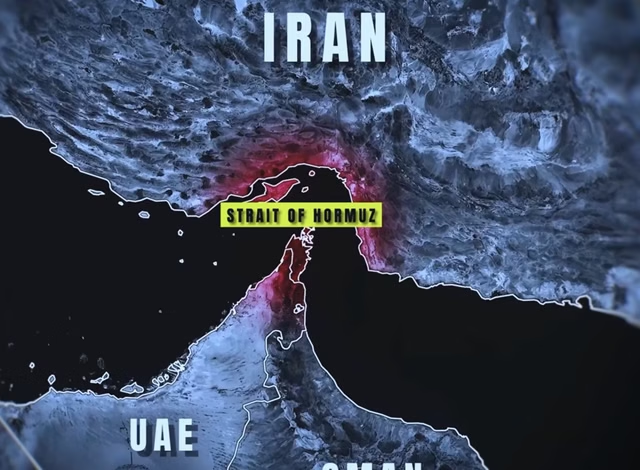
- The Strait of Hormuz is a narrow chokepoint connecting the Persian Gulf to the Gulf of Oman; a sizable share of global crude oil and liquefied natural gas transits the waterway, making it central to worldwide energy markets.
- Historically, Iran has paired long-range missiles, drones and proxy networks to project power across the region; recent losses in those capabilities have reportedly pushed Iranian planners to emphasize maritime and coastal measures that exploit Hormuz’s geography.
- Control or effective harassment of tanker traffic can produce near‑immediate ripple effects on oil prices and shipping insurance costs, creating swift economic pain for rivals without requiring large-scale conventional operations.
NEW: There is an emergent consensus in Tehran that the Strait of Hormuz is an increasingly potent lever of power and must be central to Iranian strategy moving forward. Iranian actions and rhetoric demonstrate the disruptive ways that Iran hopes to use this lever in the future.… pic.twitter.com/t4VxjqmREs
— Institute for the Study of War (@TheStudyofWar) May 13, 2026
Strategic shift
Amid the varying tactics and intensity of diplomatic and military action short of a full-scale war, there are numerous stakes involved.
The US counter-blockade on Iran already amounts to a logistics squeeze: Interdicting inbound empty tankers or delaying port operations creates bottlenecks — onshore storage fills, floating storage is costly and limited, and production may need to be curtailed if offtake is blocked.
Incidents involving the sinking of commercial ships will surely invite protests, spike oil prices and drive a potential escalation.
Tensions between Tehran, the US and Gulf partners already run high. It is bound to complicate regional diplomacy, especially given broader tensions.
It’s been reported that despite the security situation, multiple India-bound LPG tankers continued crossing the Strait of Hormuz over the past 24 hours.
The attack on an Indian-flagged vessel could prompt formal protests; conversely, it risks reciprocal measures.
GN


