



Understanding My Autistic Son Through Doctor Who

The film Elf is a no-go in our house. My son interprets it as the psychological horror story of a man who is telling the truth but is constantly disbelieved. He loves The Traitors and rewatches entire series of it – knowing who the traitors are gives him an autonomy and comfort watching the game. Any other kind of conflict on screen and he’ll leave the room or wind it forward. I tried to explain that there are no stories without conflict. It made no difference.
My son is autistic and has ADHD – what’s sometimes referred to as AuDHD. We’ve always called him “fizzy”. He’s often the noisiest person in a room but hates too much noise. He’s incredibly sociable and wants so desperately to be part of the fun but finds the fun stressful. I had never seen anyone like him represented on screen.
And then I put on Doctor Who. It was a punt – my son was eight and he liked science. We went in at the David Tennant era – beginning with the episode The Christmas Invasion, where the Doctor doesn’t wake up till a third of the way through the episode. Suddenly there, standing in his pyjamas with a big boyish grin, was Tennant, describing a frightening alien with a weapon as a “big fella”. My son grinned back at the screen. When Tennant’s Doctor arrives properly, he barely stops talking or moving. He’s sword-fighting, then joking, then forgiving – and then he kills the baddy with a satsuma. All while repeating certain phrases to himself. My son laughed in recognition (he often repeats phrases to himself). He turned to me, eyes wide.
“He’s like me!” he said.
“You mean funny? Yes, you are very funny, luv.”
“No,” he insisted. “He’s fizzy. Like me.”
Watching Tennant’s Doctor was like watching an adult version of my son: the infectious joy, the righteous anger, veering so suddenly from one emotion to the other. A fierceness to it all – a fizz. I don’t think David Tennant purposely played the Doctor as AuDHD, or that Russell T Davies wrote him that way. But when we watched those episodes together, that’s what we saw. That’s who we saw. And my son saw himself.
He found comfort in the structure of it. Every episode there’d be a new problem and the Doctor would use his fizzy brain to solve it. It helped him understand that stories need conflict, and then resolution. That real life has conflict and resolution, too. It helped me find parallels between what happened in the episodes and what was happening in his life. “The Doctor really likes hanging out with humans even though he finds them a bit stressful, doesn’t he?” I’d say. “Do you think that’s a bit like you and your friends sometimes?”
One Friday afternoon, my son exploded about something I can’t even remember now. It was the week at school pouring out of him in a screaming, kicking tangle of limbs. In the remorse that followed, I said something I’d said many times before: “Your feelings and emotions are just so big for such a little person.”
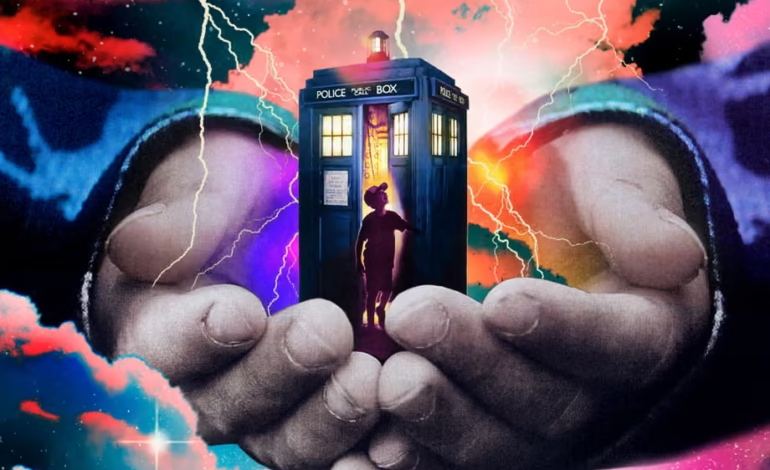
But then I had a sudden realisation, from all the Doctor Who we’d been watching. I squeezed his hands in mine. “You’re like a Tardis. You’re just so much bigger on the inside than you are on the outside, my love.”
He nodded back. “I am like a Tardis.”
The Guardian